
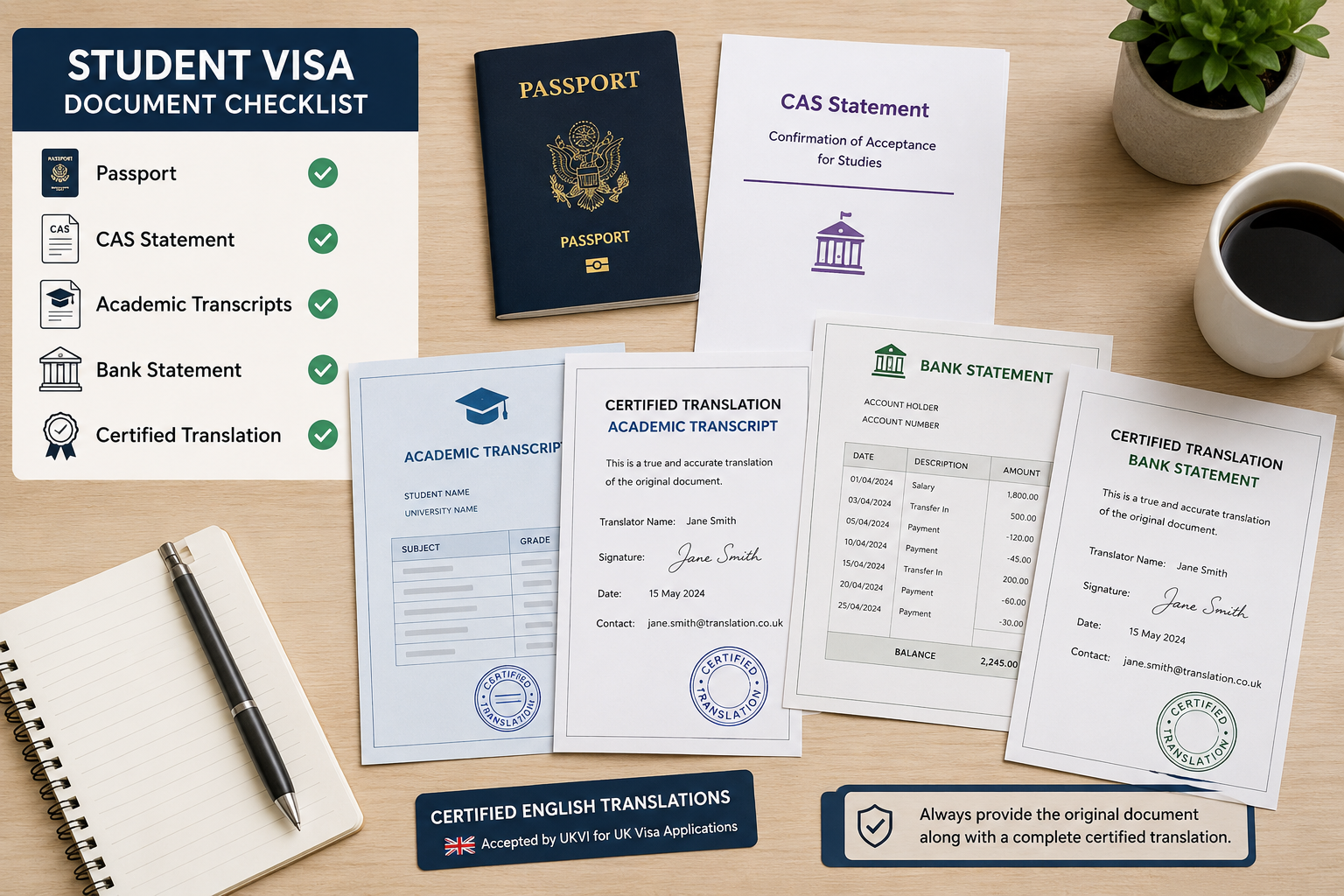
Understanding UKVI Translation Requirements
When applying for a UK visa, one of the critical components is the submission of supporting documents. These documents often need to be translated into English if they are originally in another language. The UK Visas and Immigration (UKVI) has specific guidelines regarding who can translate these documents, which raises the question: Can I translate my own documents for a UK visa?
Can I Translate My Own Documents for UK Visa?
For most visa evidence, you should not rely on a self-translation. GOV.UK guidance requires a full translation that can be independently verified by the Home Office, and route-specific guidance such as the Student route requires a fully certified translation from a professional translator or translation company. Check the current GOV.UK supporting-document guidance for the route you are applying under.
Why Can’t You Translate Your Own Documents?
There are several reasons a self-translation can create problems for a UKVI application:
- Objectivity: A translator must be impartial and not personally invested in the content of the documents.
- Accuracy: Professional translators are trained to convey the meaning of the original text accurately, including nuances and context that a non-professional might miss.
- Certification: Translations submitted to UKVI must be certified, which typically requires a professional translator or translation service to attest to the accuracy of the translation.
What UKVI Needs to See in a Certified Translation
If a supporting document is not in English or Welsh, provide the original document together with a complete English translation that can be independently verified by the Home Office. The translation should include the required translator details, date and confirmation of accuracy. Some visa routes specifically require a fully certified translation from a professional translator or translation company.
A suitable certified translation should normally include:
- A statement confirming that the translation is accurate and complete
- The date of translation
- The translator’s full name and signature, or the signature of an authorised representative of the translation company
- The translator’s or translation company’s contact details
- Clear formatting that allows the translated text to be matched with the original document
The exact translation wording can vary by immigration route, so check the guidance that applies to your application. For common routes, see our Student visa translation, Skilled Worker visa translation and Spouse visa translation pages.
Who Can Translate for UKVI?
The safest option for visa evidence is a professional translator or translation company that can provide the required certification details and can be independently verified. Always check the guidance for your specific route.
Professional Translation Services
Using a certified translation service is a straightforward way to meet the document requirements for many UK visa routes. UKVI Translation prepares certified translations for visa, immigration and Home Office submissions.
Qualified Translators
A qualified professional translator may also prepare the translation where the route guidance allows it, provided the translation includes the required confirmation of accuracy, date, identifying details, signature and contact information.
Family Members, Friends, Sponsors and Employers
For UK visa evidence, it is safer not to use a family member, friend, sponsor, employer, colleague, or anyone else with a personal interest in the application to translate your documents. Even if they are fluent in both languages, the translation may not be treated as independent.
Use an independent professional translator or translation company that can certify the translation, include the required translator details, and provide a clear statement of accuracy. This helps avoid questions about impartiality, completeness, or whether the translation can be verified.
UKVI Translator Requirements
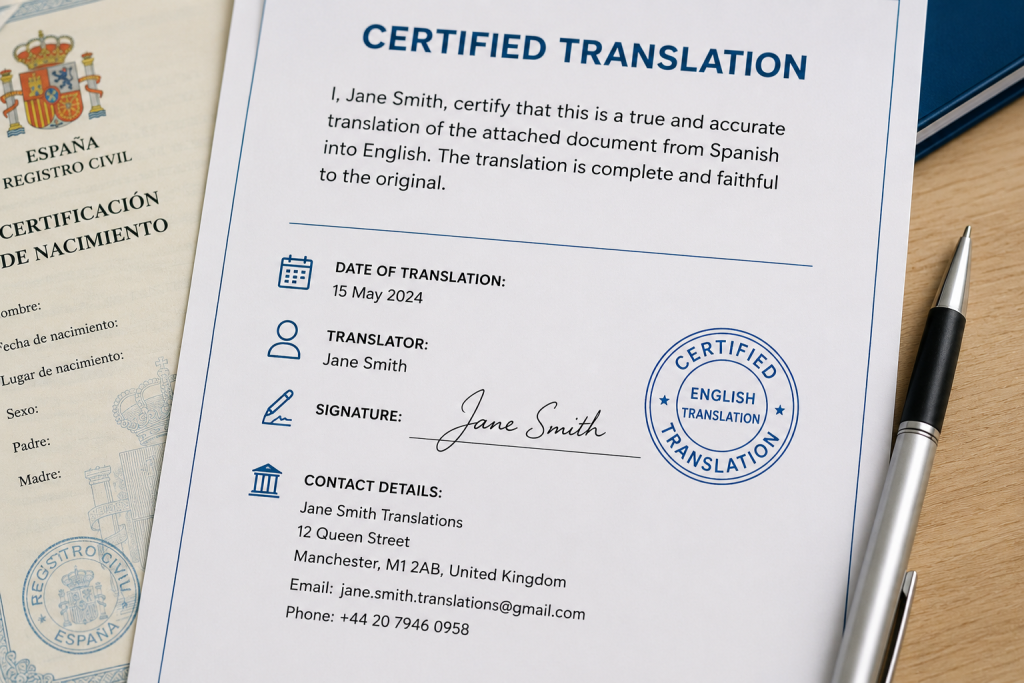
When selecting a translator or translation service, ensure they meet the following UKVI requirements:
- Certification: The translation must be certified, meaning the translator attests to its accuracy.
- Contact Information: The translator’s name, signature, and contact details must be included.
- Language Proficiency: The translator should be fluent in both the source language and English.
- Experience: Ideally, the translator should have experience with legal or immigration documents.
What Documents Typically Require Translation?
Several types of documents may require translation for a UK visa application:
- Birth certificates
- Marriage certificates
- Academic transcripts
- Employment letters
- Police clearance certificates
Student Visa Documents: When Translation Is Needed
For a UK Student visa, you may need certified translations if any required supporting documents are not in English or Welsh. This can include academic, financial, identity, relationship, or consent documents, depending on your circumstances.
Common Student visa documents that may need translation include:
- Academic transcripts or qualification certificates used for your course offer
- Bank statements or financial evidence
- Financial sponsorship letters or related proof
- Birth certificates or relationship documents for under-18 applicants
- Parental or legal guardian consent documents
- Household registration documents, where used as supporting evidence
- Any official document requested by your university, sponsor, or UKVI that is not in English or Welsh
Your CAS is normally issued by your education provider, but any supporting evidence you upload with your application should be checked carefully. If a document is partly in another language, or includes stamps, seals, handwritten notes, or official annotations, those parts should also be translated clearly.
Skilled Worker Visa Documents: When Translation Is Needed

For a Skilled Worker visa, some documents are issued electronically or in English, such as the Certificate of Sponsorship reference from your employer. However, other supporting documents may still need certified translation if they are not in English or Welsh.
Common Skilled Worker visa documents that may need translation include:
- Criminal record certificates, where required for your occupation
- Marriage certificates or birth certificates for dependants
- Evidence of relationship for a partner or child applying with you
- Bank statements or financial documents, where personal savings evidence is needed
- Overseas qualification certificates, where relevant to your application
- ATAS-related documents, if your role or research area requires additional evidence
- Tuberculosis test documents, if issued in a language other than English or Welsh
If your employer, sponsor, or adviser asks you to provide a supporting document, check the language before upload. A document that proves an important part of your Skilled Worker application should not be submitted without a certified English translation if it is written in another language.
Checklist Before You Upload Translated Documents

Before submitting translated documents with your UK visa application, check the following:
- The original document is included with the translation
- The full document has been translated, not only selected sections
- Names, dates, reference numbers, stamps, seals, and handwritten notes have been handled clearly
- The translation includes a statement confirming accuracy
- The translation is dated
- The translator or translation company is clearly named
- The translator or authorised company representative has signed the certification
- Contact details are included so the translation can be checked if needed
- The file is clear, legible, and uploaded in the correct format
- The translation matches the same name spellings and date formats used across your application where possible
Small inconsistencies can create unnecessary questions, especially with visa documents. It is worth checking every translated file before you submit the application.
Cost of Professional Translation Services
The cost of professional translation services can vary widely based on several factors:
- Document Length: Longer documents will naturally cost more to translate.
- Language Pair: Some languages may be more expensive to translate due to the availability of qualified translators.
- Urgency: If you need a quick turnaround, expect to pay a premium.
Pricing depends on the document length, language pair, formatting, certification and deadline. See our current certified translation prices for the site’s published starting rates and turnaround options.
How to Choose a Translation Service
When selecting a translation service, consider the following:
- Reputation: Look for reviews and testimonials from previous clients.
- Experience: Ensure they have experience with UKVI translations.
- Certifications: Verify their credentials and certifications.
Common Mistakes to Avoid Before Submitting Translated Documents
Many translation problems are avoidable if you review the documents before uploading them. Common mistakes include:
- Translating the document yourself to save time or money
- Asking a friend, family member, employer, or sponsor to translate it
- Uploading the translation without the original document
- Sending only a partial translation
- Leaving out stamps, seals, signatures, handwritten notes, or official remarks
- Using a translation that does not include the translator’s contact details
- Forgetting the date or signature on the certification statement
- Uploading a blurry scan that cannot be read properly
- Using different spellings of names across translated documents
- Waiting until the day of submission before arranging translations
For Student visa and Skilled Worker visa applications, translated documents often support important evidence such as finances, qualifications, family relationships, or criminal record checks. Treat the translation as part of your evidence, not as a last-minute formality.
Example Scenarios

Student visa example
A student has a CAS from a UK university and needs to upload financial evidence from an overseas bank. The bank statement is not in English or Welsh, so the student arranges a certified English translation before submitting the visa application. The translation includes the translator’s details, date, signature, and confirmation that it is an accurate translation of the original document.
Skilled Worker visa example
A Skilled Worker applicant is applying for a healthcare role and needs to provide a criminal record certificate from a country where they previously lived. The certificate is not in English or Welsh, so the applicant submits the original certificate together with a certified English translation. This allows the document to be reviewed clearly as part of the visa evidence.
These examples show why translations should be prepared before upload, especially where the document supports a key part of the application.
Questions Clients Often Ask
Can I translate my own documents for a UK visa?
You should not rely on a self-translation where the route requires a certified professional translation. More generally, Home Office guidance requires translations to be complete and independently verifiable, with the translator’s identifying and contact details included.
Can I translate my own documents for a Student visa?
No. If a Student visa document is not in English or Welsh, use a certified English translation from an independent professional translator or translation company. This is especially important for financial evidence, academic documents, parental consent documents, and relationship evidence.
Can I translate my own documents for a Skilled Worker visa?
No. If a Skilled Worker visa document is not in English or Welsh, it should be accompanied by a certified English translation. This may apply to criminal record certificates, relationship documents for dependants, overseas qualifications, financial evidence, or other supporting documents.
Can I use a translation done by a friend or family member?
It is safer not to use a friend or family member. UK visa translations should be independent, certified, and verifiable. A friend or relative may be fluent in both languages, but they are not usually the right person to certify evidence for a visa application.
What if my document is already in English?
If your document is already fully in English, you normally do not need to translate it. If the document contains stamps, handwritten notes, seals, or sections in another language, those parts may still need to be translated.
How long does it take to get documents translated?
Turnaround depends on the language, length, formatting, and urgency of the document. Many standard certificates can be translated quickly, while longer financial, academic, legal, or employment documents may need more time.
What happens if my translation is not accepted?
If a translation is not accepted or cannot be verified, you may need to provide a new certified translation. This can delay your application, especially if the translated document supports an important requirement.
Do Student visa translations need to be notarised?
Not usually. For most UK visa applications, a certified translation is normally the key requirement. Notarisation is a separate process and is not the same as a certified translation. Check your specific instructions if you have been asked for notarisation.
Do Skilled Worker visa translations need to be notarised?
Usually, a certified translation is enough for Skilled Worker visa evidence unless you have been specifically told to provide something else. The translation should be complete, accurate, signed, dated, and include translator or translation company contact details.
What should a certified translation include?
A certified translation should include a statement confirming accuracy, the translation date, the translator’s full name and signature or authorised company signature, and the translator’s or company’s contact details.
Need the Translation Service for Your Visa Route?
If you are preparing documents for a Student visa, Skilled Worker visa, dependant application, extension, or another UK visa route, we can help you arrange certified English translations before you submit your application.
Send your documents securely, tell us your visa route and deadline, and we will confirm the translation requirements, quote, and expected delivery time.
Request a quote and upload your documents when you are ready to confirm the price, certification route and turnaround.
Conclusion
In summary, UKVI and Home Office guidance focuses on a complete translation that can be independently verified, while some visa routes explicitly require a fully certified translation from a professional translator or translation company. Check the guidance for your route and use a translation that contains all required certification details. For help preparing one, see UKVI certified translation services.
1 comment